NASA’s Juno spacecraft has beamed home the first-ever photos of Jupiter’s poles, and scientists can hardly believe their eyes.
Storm systems and weather activity unlike anything encountered in the Solar System are on view in these images of Jupiter’s north polar region. The two images have been contrast-enhanced differently to bring out detail near the dark terminator and near the bright limb. Image credit: NASA / JPL-Caltech / SwRI / MSSS
Juno captured the images on Aug. 27, 2016, when the probe skimmed just 2,600 miles (4,200 kilometers) above the planet’s swirling clouds during the first of three dozen close flybys of the king of the solar system’s planets. The images show both of Jupiter’s poles are covered in Earth-sized swirling storms that are densely clustered and rubbing together.
“First glimpse of Jupiter’s north pole, and it looks like nothing we have seen or imagined before,” Juno principal investigator Scott Bolton, of the Southwest Research Institute in San Antonio, said in a statement.
“It’s bluer in color up there than other parts of the planet, and there are a lot of storms,” Bolton added. “There is no sign of the latitudinal bands or zone and belts that we are used to; this image is hardly recognizable as Jupiter. We’re seeing signs that the clouds have shadows, possibly indicating that the clouds are at a higher altitude than other features.”
He added: “Saturn has a hexagon at the north pole. There is nothing on Jupiter that anywhere near resembles that. The largest planet in our Solar System is truly unique.”
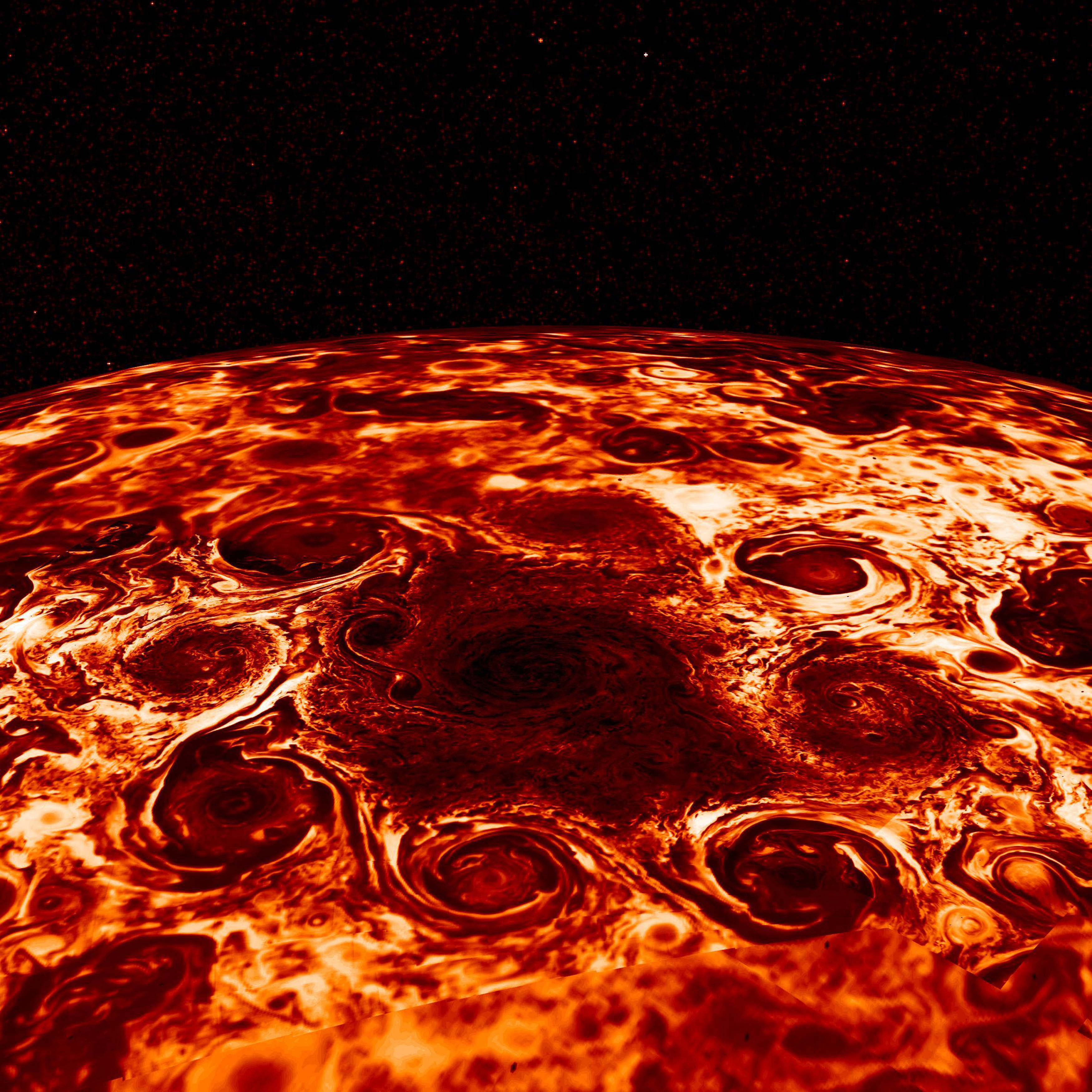
This composite image, derived from data collected by the Jovian Infrared Auroral Mapper (JIRAM) instrument aboard NASA’s Juno mission to Jupiter, shows the central cyclone at the planet’s north pole and the eight cyclones that encircle it. JIRAM collects data in infrared, and the colors in this composite represent radiant heat: the yellow (thinner) clouds are about 9 degrees Fahrenheit (-13° Celsius) in brightness temperature and the dark red (thickest) are around -181 degrees Fahrenheit (-118.33° Celsius). Image credit: NASA/JPL-Caltech/SwRI/ASI/INAF/JIRAM
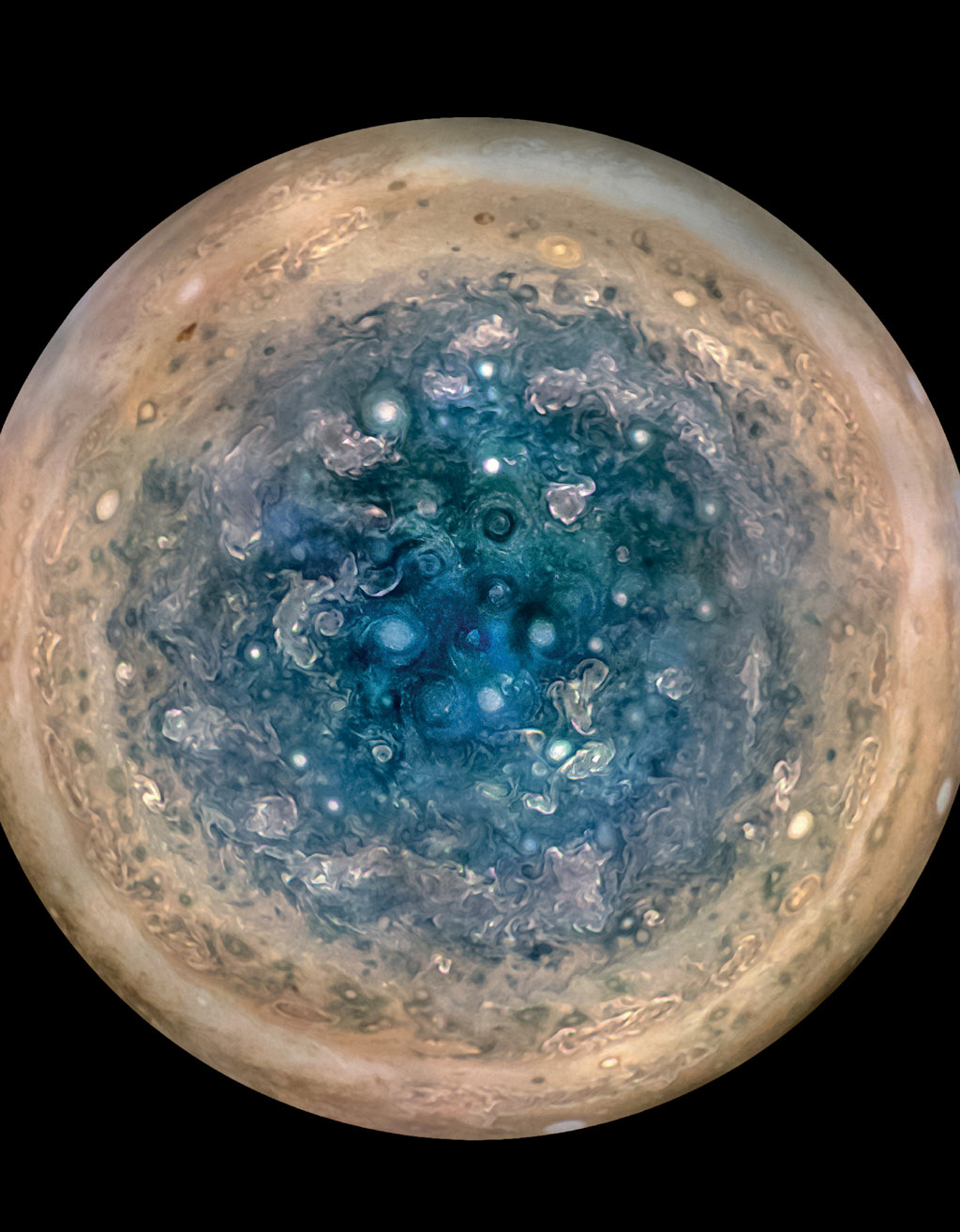
This image shows Jupiter’s south pole, as seen by NASA’s Juno spacecraft from an altitude of 32,000 miles (52,000 kilometers). Image credit: NASA/JPL-Caltech/SwRI/MSSS/Betsy Asher Hall/Gervasio Robles
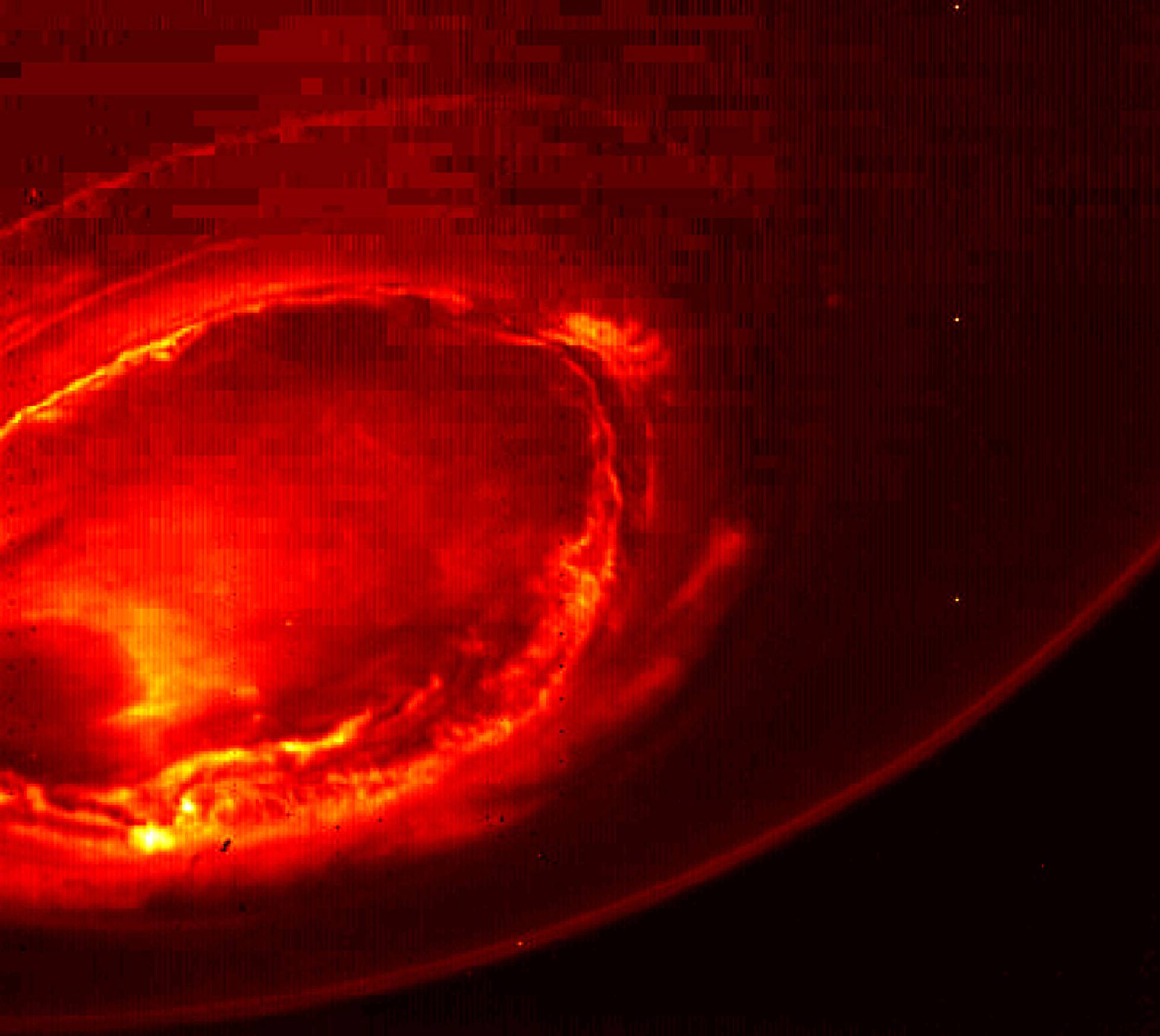
This infrared image gives an unprecedented view of the southern aurora of Jupiter. The gas giant’s southern aurora can hardly be seen from Earth due to our home planet’s position in respect to Jupiter’s south pole. Juno’s unique polar orbit provides the first opportunity to observe this region of the planet in detail. Image credit: NASA / JPL-Caltech / SwRI / MSSS.
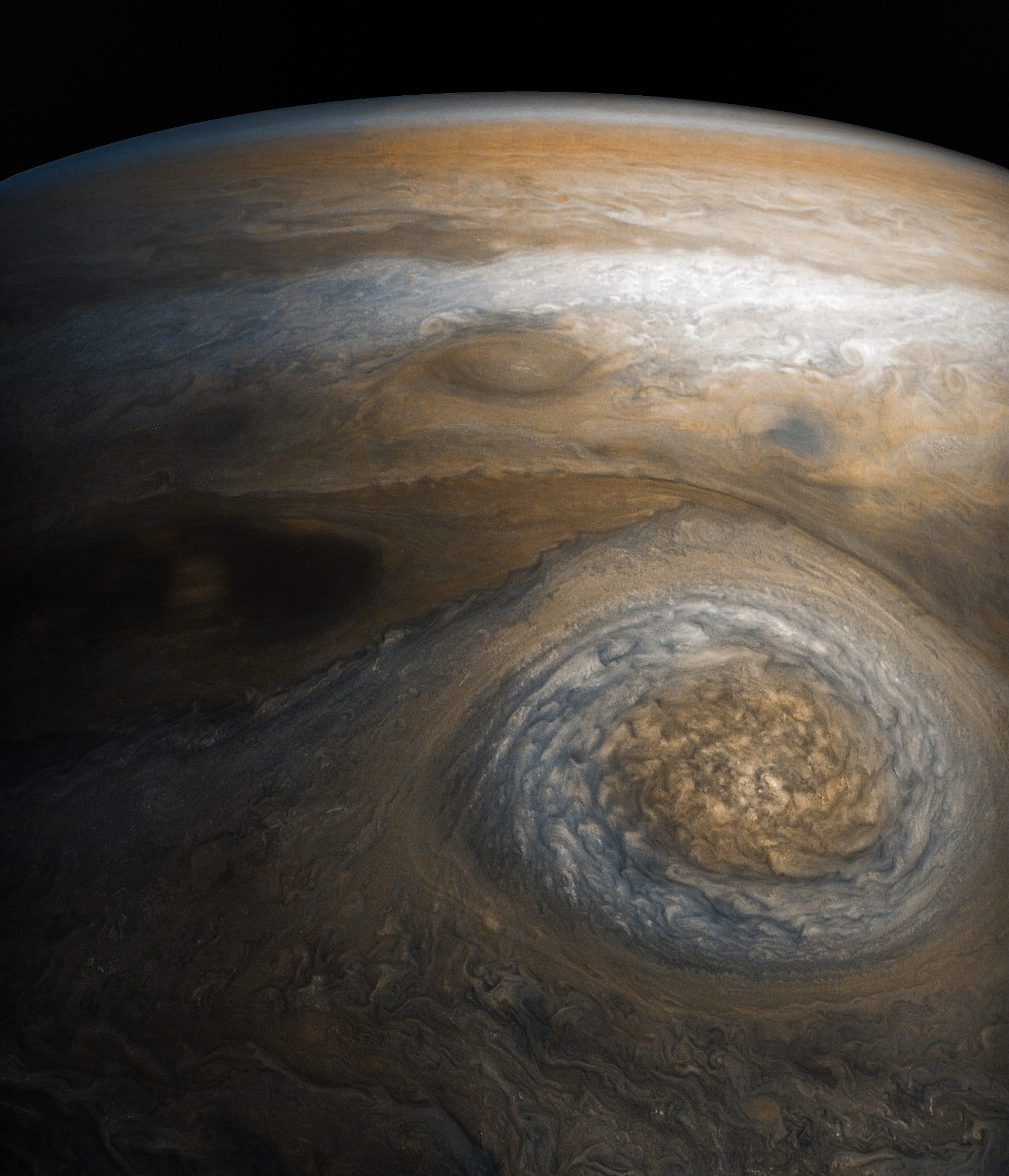
The Great Red Spot of Jupiter, as seen by the Juno Spacecraft on 12 July 2017. Image credit: NASA / SwRI / MSSS / Gerald Eichstädt / Seán Doran
A sociologist and English major by degree, I've worked in the area of civil society & human rights and have been blogging in the fields of travel, nature & science for over 20 years.
Check out my other project (especially if you're planning to visit Budapest soon) 👇

 Donate


Related Posts
Mesmerizing Timelapse Reveals Jupiter’s Cloud Belts Moving at Different Speeds and Directions
What Everyday Things Look Like Under the Microscope
Jupiter’s Stunning Auroras Revealed in New Images, Solving Their Long-Standing Mystery
What Would Earth Look Like With Saturn’s Rings?
Slime Moulds Don’t Only Look Fascinating, They’re Also Much Smarter Than You’d Expect
Art of the Earth: These Amazing Satellite Images Look Like Abstract Paintings
These Are the Only Images Ever Made on the Surface of Venus
Exploring the Amazon from Above: Breathtaking Images of the World’s Largest River System Taken From the ISS
This Unusual Black Cloud in the Milky Way Has Revealed Amazing Secrets
NASA is Building a Rover to Explore Jupiter’s Moon Europa From Underneath Its Icy Shell