AI seems to be promoting unrealistic beauty standards, which is by no means surprising.

The unrealistic beauty standards presented in the media and on social media have a significant effect on how we, especially the younger generations, view ourselves, and now it seems that AI could take it one step even further. Eating disorder awareness group The Bulimia Project wanted to find out how far exactly.
More specifically, the organization wanted to see what “ideal” body types are being promoted by the billions of images on social media and just how distorted they are from reality. So they asked the most popular image generators such as Dall-E 2, Stable Diffusion, and Midjourney, what they think the ideal man and woman looks like.
So let’s see the results. Spoiler: the images are even more unrealistic than the ones you see on Instagram and its likes.

According to the team’s findings, 40 percent of the AI-generated images featured unrealistic body types, with a slightly higher occurrence among men than women. Additionally, a significant 53 percent of the images depicted individuals with olive skin tones, while 37 percent showcased people with blonde hair.
When prompted to create “the ‘perfect’ female body according to social media in 2023,” “smaller women appeared in nearly all the images created by Dall-E 2, Stable Diffusion, and Midjourney, but the latter came up with the most unrealistic representations of the female body,” the project team wrote in a post detailing their findings. “The same can be said for the male physiques it generated, all of which look like photoshopped versions of bodybuilders.”

The team then requested the generators to produce images representing a more generalized concept of the “perfect” woman and man in 2023. Based on the findings, the primary distinction observed between the two prompts was that the images derived from social media had a higher degree of sexualized content and included more exaggerated and unrealistic body features.
“Considering that social media uses algorithms based on which content gets the most lingering eyes, it’s easy to guess why AI’s renderings would come out more sexualized. But we can only assume that the reason AI came up with so many oddly shaped versions of the physiques it found on social media is that these platforms promote unrealistic body types, to begin with,” the team wrote.
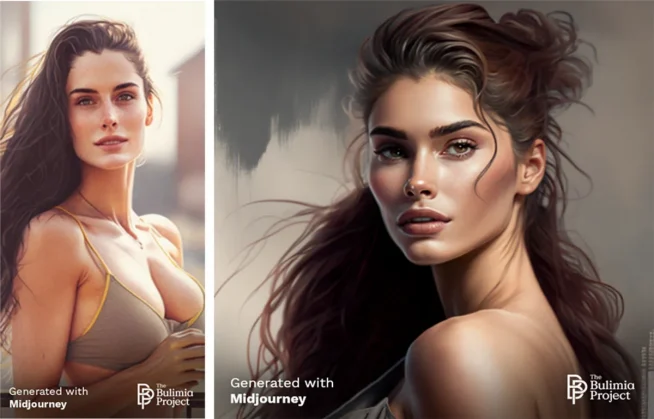
AI generators have been frequently found to exhibit racist and sexist biases, often reflecting the biases present in the datasets used to train them. The Bulimia Project’s research findings indicate that these generators also display a bias towards generating images with unrealistic body types.
“In the age of Instagram and Snapchat filters, no one can reasonably achieve the physical standards set by social media,” the team wrote, “so, why try to meet unrealistic ideals? It’s both mentally and physically healthier to keep body image expectations squarely in the realm of reality.”

Fortunately, efforts are underway to develop tools that can identify and highlight these biases, signaling progress in addressing the issue. However, it remains vital to educate the general public about the distorted realities they may increasingly encounter. This becomes particularly crucial as AI advances, blurring the line between authentic photography and technologically generated content, making it more challenging to discern what is real.
 Donate


Related Posts
Sora, OpenAI’s New Video Generation Model Creates Dreadfully Mesmerizing Videos
AI Stabilization Reveals Clearer View of Famous Bigfoot Footage and What It Actually Is
This is How Dead Celebrities Would Look If They Were Still Alive, According to AI