
We have already published a great infographic of Kowloon Walled City in Hong Kong that was once the most densely populated place on earth despite being constructed without a single architect or any oversight whatsoever.
Now, we are taking a closer look at what life was like in the City of Anarchy, with the help of historical photos and accounts. But first, here’s another fascinating (and extremely detailed) cross section illustration of this ungoverned hive of interlinking buildings, which became a haven for drugs, crime and prostitution until it was demolished in 1993 (click image to enlarge).
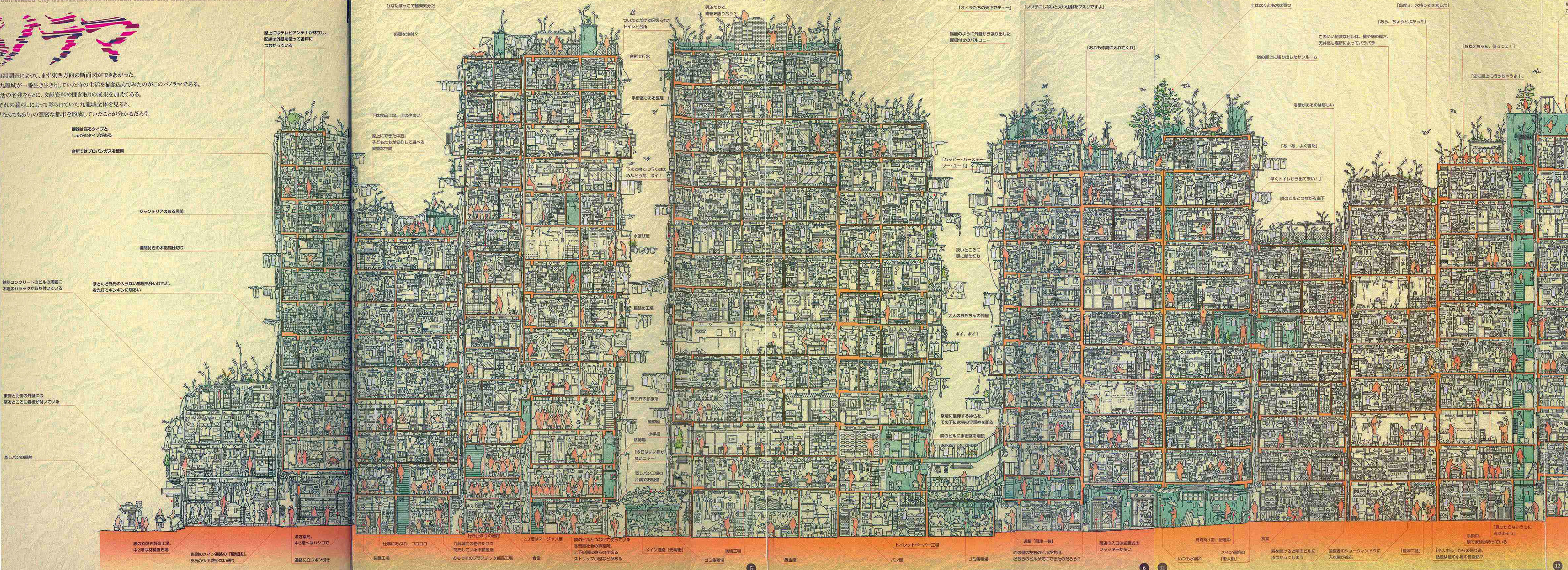
As the infographic testifies, Kowloon Walled City was a densely populated, chaotic enclave situated within the boundaries of Kowloon City in Hong Kong. It existed outside of the law, with no government regulation or oversight. Life within its cramped confines was a dystopian experience quite unlike anywhere else on Earth.
Originally built as a military fort by China in the 19th century, the Walled City became a bizarre geographic anomaly after the New Territories were leased to Britain in 1898. While the surrounding area fell under British rule, the Walled City itself remained under Chinese jurisdiction, at least officially. However, neither country truly governed or provided services to the ramshackle settlement that grew up within the former fort’s walls after World War II.

As a power vacuum formed, Kowloon blossomed into an anarchic enclave populated by refugees fleeing the Chinese Civil War. By the late 1980s, an estimated 33,000 people were crammed into just 6.4 acres of densely built territory. With no enforceable laws or bureaucracy, the Walled City became a haven for crime, from rampant prostitution and gambling to illegal manufacturing and drug trafficking, with law and order were loosely enforced by Triad gangs. However, for many residents, it was simply a way of life, a way to survive in a place where opportunities were scarce.

Despite the seemingly chaotic layout, a strong sense of community existed. Residents relied on each other for necessities and formed networks to navigate the labyrinthine city. The cramped residential towers, linked by a bewildering tangle of alleyways and bridges, became one sprawling, organic megastructure teeming with human activity. Small businesses thrived, producing everything from clothes to noodles within the cramped quarters.

Natural light was virtually nonexistent in the narrow corridors cloaked in permanent dim shadows. Dripping water pipes snaked across walls and ceilings, forcing residents to wear hats or carry umbrellas to stay dry. Raised walkways connected the higgledy-piggledy towers, some over a dozen stories tall despite having no proper foundations. Windows were misaligned, with odd geometries rapidly built outwards in any direction that space allowed.

The sights, sounds and smells assaulted the senses at every turn. Entire corridors were coated in a fine flour dust from noodle factories operating behind makeshift doors. Overwhelming chemical stenches from plastic and metal manufacturers wafted through the air. The clicking of mah-jongg parlors and the cries of hawkers blended with the drone of industrial machinery.

By night, the Walled City transformed into a neon-soaked den of iniquity. Smoky gambling parlors operated alongside strip clubs and pornographic cinemas. Prostitutes of all ages solicited customers from dimly-lit corners to be whisked away to backroom brothels. Opium dens filled with stupefied people lying prone on dilapidated divans. And everywhere, addicts hunched in derelict spaces chasing the dragon by heating heroin on tinfoil to inhale the toxic fumes.

Yet amidst the vice and squalor, normal life persisted for many residents simply trying to get by. Entire families worked production lines in the hundreds of informal factories pumping out goods from fish balls to textiles to be exported to the rest of Hong Kong. Wives handled housekeeping duties while grandmothers watched over young children. Religious institutions like temples and the old yamen building provided spaces for socializing and community activities.
On the rooftops crisscrossed by mazes of rusting metal ladders, children played and did homework away from the shadowy alleys below. The flat roofs became cherished open spaces for residents of the upper floors to gather, relax and enjoy what little sunshine made it into the dense concrete jungle.

Tight living quarters meant privacy was virtually nonexistent. But the closeness bred a sense of unity, with neighbors forming strong social bonds and community groups to improve daily life any way they could. Most were simply focused on scratching out an existence in extremely trying circumstances.
To some outsiders, however, Kowloon represented an anarchist utopia – a self-governing vessel of pure freedom operating entirely outside typical societal constraints. In the absence of any regulation or formal economy, a thriving gray market and shadow industries emerged to service the city’s endless need for services and goods.

Shops, restaurants, unlicensed medical clinics and dentist offices catered to residents, with auctioned apartments providing income streams for slum landlords. The surroundings may have seemed dystopian, but daily life for many within the Walled City carried on around the clock, with familiar routines and transactions simply adapted to the unique anarchic setting.

The freewheeling days inevitably came to an end as the expiry of Britain’s 99-year lease over Hong Kong loomed. In 1987, the colonial government announced plans to demolish the notorious Walled City slum that had grown far beyond its original borders. A hard-fought eviction and demolition process eliminated the last residences of the ungoverned enclave by 1994.
Today, a carefully manicured park stands on the former footprint of the anarchic Kowloon settlement. While the City of Darkness has been razed and sanitized, its legacy as one of the most extreme examples of urbanization on Earth persists. It showed humanity’s ability to establish a thriving if unorthodox community in even the most nightmarish of environments when left with no other choice.

For a few chaotic decades, the Walled City offered a glimpse into how far humanity’s resilient spirit could push the boundaries of city living in the face of overwhelming adversity. Whether hellish dystopia or anarcho-libertarian thought experiment, Kowloon epitomized humanity’s capacity to adapt and introduce pockets of order into even the most disordered of circumstances.
 Donate


Related Posts
How the Babylonians Counted to 60 Using Their Hands and Changed Mathematics Forever
La Rinconada, Peru: The World’s Highest Town — and One of Its Most Lawless
Finally, a World Map That Gets It Right: The AuthaGraph Projection
Streets, Buildings, and Tombs: Pavlopetri, the Oldest Known Submerged City Has a Complete Surviving Town Plan
Orvieto Underground: This Massive Subterranean City in Italy Was Only Rediscovered After a Landslide in the 1970s
Tabula Peutingeriana: The Most Extensive Surviving Map of the Roman Empire Is the Only One to Show Its Vast Road Network
A City That Fills Its Tiny Island Completely: Malé, One of the Most Densely Populated Places on Earth
This Is the Oldest Known Map of the World, Made in Babylon About 2,600 Years Ago
The Fascinating 6000-Room Georgian Cave City of Vardzia That Was Built by the Queen Who Was a King
Nightmare Fuel Around the World: What “Boogeyman” Looks Like in Different Countries