Twice a year, the picturesque and otherwise quiet village of Kayabuki no Sato in Japan puts on a spectacular water display. The event does attract tourists, but its real purpose is to test a forest of 62 fire extinguishers scattered across the historic site.

Tucked away in a mountainous region of Japan’s Gifu Prefecture is a small village of Gassho-style houses – uniquely Japanese structures with thatched roofs that are built to withstand heavy snowfall. Founded in the 11th century, the historic community of Kayabuki no Sato was recognized as a UNESCO World Heritage Site in 1995.
Besides the tourists who come to study the architecture and local history, twice a year an unusual attraction draws larger crowds to the village.

The spectacle has an important backstory. A devastating fire in a historical archive facility two decades ago prompted future protective measures. In wake of a cultural loss, a fun new tradition was born.
The testing of the town’s impressive fire extinguishing system has become a tourist attraction.

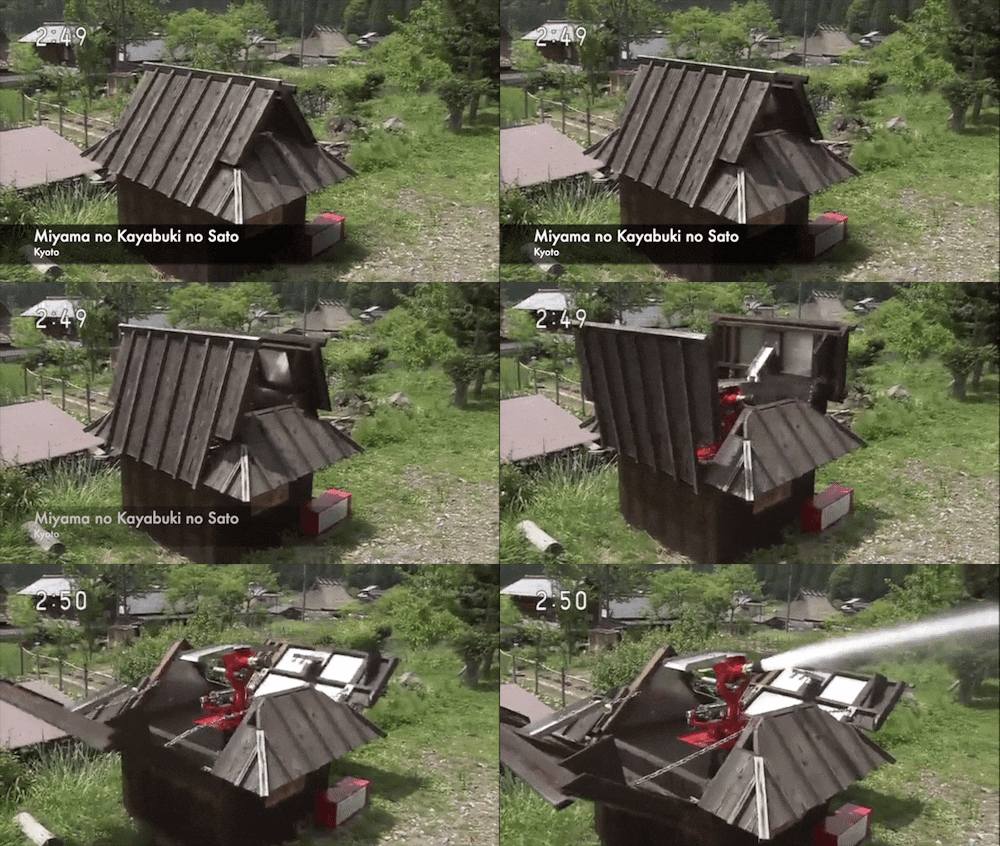
Just before the (houses and passersby) are doused with water, small hut-like structures designed in the traditional style of the village open up their roofs to reveal hidden mechanical sprinklers. While each hut transforms to a fire-fighting device, intense streams of water shoot up into the sky and rotate from left to right. This event has been fittingly dubbed the “Water Hose Festival.”
Here’s what the small huts look like closed and open:


And here’s one of them in action:
And all of them in action:

“Gassho”, the style the buildings were built in, refers to a hand pose that is used when one brings both hands together to pray. The thatched roofs are built in a similar manner to allow snow to easily fall off the sides. This distributes the load and keeps the roof from collapsing.
Of course, a village with many historic thatched roofs needs extensive fire protection.

Visitors to Kayabuki no Sato can experience living in one of these traditional structures themselves. Some of the forty houses are available for rent, allowing visitors to enjoy a peaceful getaway surrounded by mountains and architecture dating all the way back to 11th century Japan. Once the water stops flowing, there’s still plenty to do as you can visit local restaurants, biking paths, and small museums in the village.
Interested in seeing the big fire extinguishing event? Plan a trip for May or December. But even if you miss it, the beautiful historic architecture makes this village worth a visit all on its own.
 Donate


Related Posts
The Road to Heaven: China’s Tianmen Mountain Big Gate Road Might Be the Craziest Drive on Earth
Nördlingen, the Medieval German Town Built from Diamonds in a Meteorite Crater
Island in Lake on Island in Lake on Island in Lake: This Is the World’s Only 5th Order Recursive Island
500 Days in Darkness: The Long-Buried Story of Priest’s Grotto, a Holocaust Refuge in One of the World’s Longest Caves
Kutkhiny Baty: The Place That Nature Made to Look Unnatural
The Old Man of Hoy: How Scotland’s Towering Sea Stack Lost a Leg and May Soon Fall
La Rinconada, Peru: The World’s Highest Town — and One of Its Most Lawless
The Woman Who Walked Across a Continent Because She Missed Home: Lillian Alling’s Epic Journey
Castel Meur: The Little House Between the Rocks That Refuses to Be a Tourist Attraction
Every Year, the Sea Parts in Korea for a Short Time—A Natural Event Echoing Moses’ Story