
We all know that it was Magellan who first sailed around the world, but wait, is that actually right? Well, the first circumnavigation was actually much more complex and dramatic than many people realize. It’s a story of ambition, hardship, discovery, and tragedy that reveals the incredible determination of a group of sailors who achieved something that had never been done before. But was Magellan truly the first to complete this epic journey?
Ferdinand Magellan was born in Portugal around 1480 and began his career sailing in expeditions for the Portuguese crown. Over time, he developed a reputation for being a skilled navigator and an ambitious explorer. However, after falling out of favor with King Manuel I of Portugal, Magellan sought support elsewhere for his grand plan: to find a westward route to the Spice Islands, or the Moluccas (today part of Indonesia), which were rich in valuable spices like cloves and nutmeg.

Based on geographical knowledge, explorers’ accounts, and his own reasoning, Magellan had long been convinced of the existence of a passage along the coast of Brazil, connecting the Atlantic and Pacific Oceans (then known as the ‘South Sea’ or ‘Mar del Sur’), near the 40th parallel south. Early 16th-century maps, such as those by Martin Waldseemüller, speculated about a southern waterway, while Portuguese exploration along South America’s coast hinted at the vast size of the continent and the likelihood of a route at its southern end.
His decision to approach Spain with the plan enraged the Portuguese king, who tried to undermine Magellan at every step – even sending a Portuguese fleet after him during the expedition (it failed to capture him). He also threatened his family back home by ordering his house in Sabrosa to be vandalized, specifically targeting the Magellans’ coat of arms displayed on the façade.

On August 10, 1519, the Armada de Molucca – as Magellan’s fleet was called – set out from Seville, Spain, with five ships and 270 men. Their journey proved to be as perilous as it was groundbreaking, and from the outset, the expedition faced significant challenges. Most notably, there were tensions among the crew, which included Spaniards (they formed the majority), Portuguese, Italians, French and other nationalities, many of whom distrusted Magellan because of his Portuguese background.
After sailing down the Guadalquivir River to Sanlúcar de Barrameda, the fleet awaited Magellan, who was making final preparations, before entering the Atlantic on September 20. After a brief stop in the Canary Islands for provisions—which later turned out to be substandard—they sailed south along Africa’s coast to evade the Portuguese fleets sent to capture Magellan.

After enduring storms and doldrums, the ships reached Sierra Leone in West Africa. They then crossed the Atlantic, facing more storms near the Equator before finally arriving in Rio de Janeiro on December 13, 1519. A period of ensuing indulgence with local women ended abruptly when Magellan executed a sailor accused of misconduct, fueling growing resentment among the crew.
The fleet followed the South American coast southward, sailing by day and anchoring at night, in search of a strait to the Spice Islands. The Rio de la Plata offered hope but proved too shallow. As winter approached in the southern hemisphere, the fleet settled at Puerto San Julian in Patagonia (Argentina) near the 49th parallel.
Soon after landing at St. Julian, Spanish captains staged a mutiny that Magellan narrowly suppressed, despite at one point losing control of three of his five ships to the mutineers. One captain was killed, another executed, and the third marooned, while lesser conspirators were sentenced to winter labor but later freed.
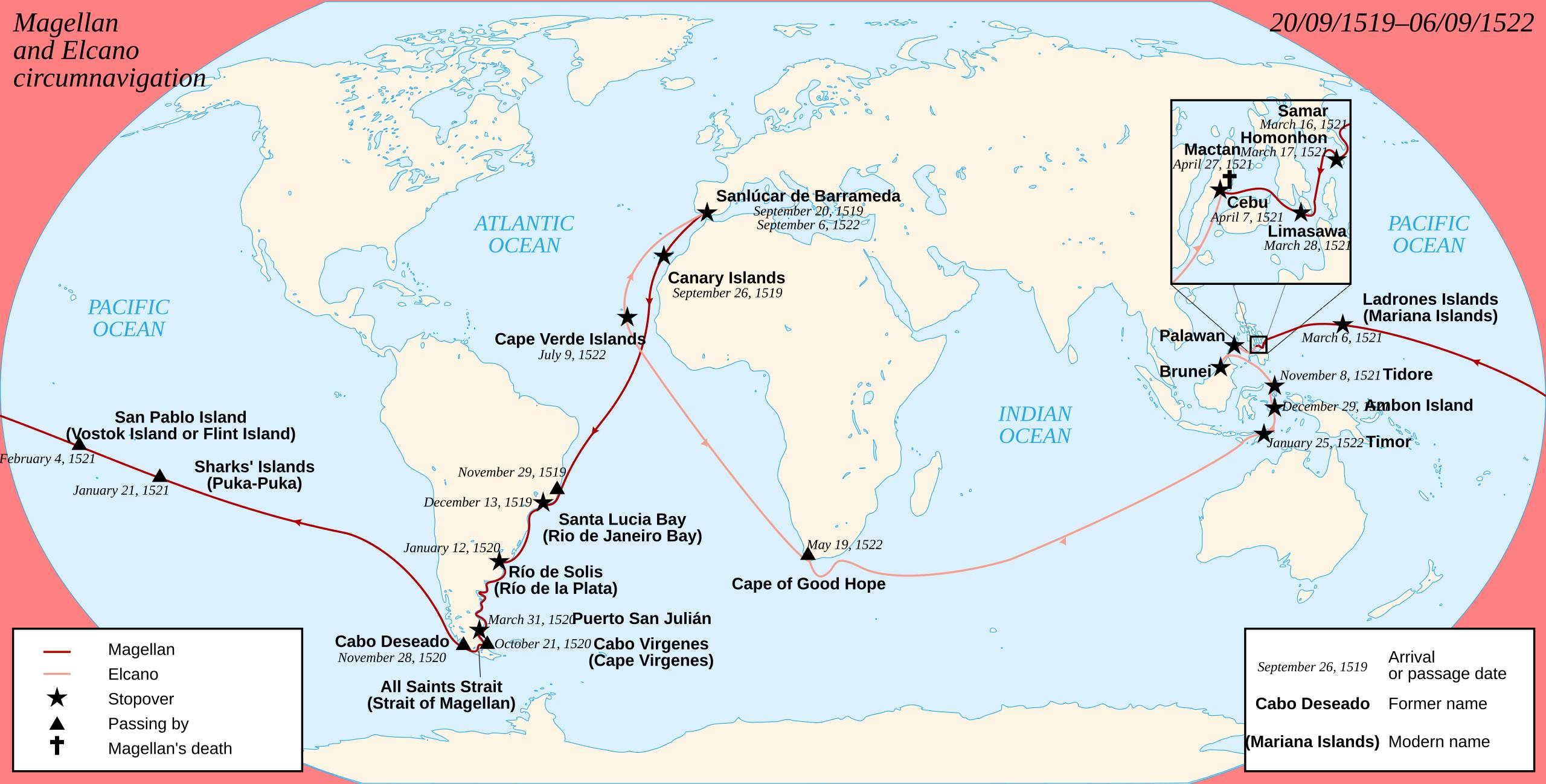
After five grueling months, the remaining four ships of Magellan’s armada set sail on August 24, 1520 (during the winter, the Santiago had been lost in a storm while surveying nearby waters, though all men survived). Despite foul weather, they reached a headland on October 21, naming it the Cape of the Eleven Thousand Virgins (today’s Vírgenes). There, they discovered a broad, deep strait with strong currents – the long-sought passage.
Navigating the strait’s 350 miles proved to be a perilous undertaking involving high tides, fierce winds, and treacherous currents. But Magellan pressed on, and over 38 harrowing days, the fleet navigated glacier-fed fjords and towering mountains, at one point also enduring a williwaw. After naming the region Tierra del Fuego upon spotting distant fires, Magellan’s ships finally reached the Pacific Ocean, proving his remarkable navigational skill and his crew’s determination.

During the passage through the perilous Strait of Magellan, their largest, provision-laden ship, the San Antonio, abandoned the expedition and returned to Spain. Its crew decided they’d had enough of the treacherous voyage and took valuable supplies with them, leaving the remaining three ships to go on with fewer resources.
When the fleet finally reached the ocean, the water was so calm compared to the Atlantic that Magellan named it ‘Mar Pacífico,’ or ‘peaceful sea.’ However, the crossing was anything but tranquil for the sailors. Magellan believed that the journey across the Pacific would take just a few days, but he was tragically mistaken – Earth’s greatest expanse of water lay ahead.

With their food supplies exhausted, the sailors were forced to survive on sawdust, strips of leather, and rats, washing it down with stale water. Scurvy, a disease caused by a lack of vitamin C, claimed many lives. Magellan himself didn’t succumb to the disease, likely because he ate a personal supply of preserved quince, which contained enough vitamin C to keep him healthy.
By the time they finally reached Guam on March 6, 1521, the crew was in desperate condition. Instead of a few days, the crossing had taken over three months. Unluckily for them, Magellan’s route north along South America’s coast and then west largely bypassed the Pacific’s 25,000 islands (a miracle in itself, albeit a painful one). During the 99-day trip, they sighted land only once: the barren atolls of the Tuamotu Islands, which Magellan named the Islands of Disappointment.

The fleet approached Guam with relief but caution, anchoring in a turquoise lagoon (now Umatac Bay). The taller, stronger local Chamorro people surrounded the fleet in their multihulled proas, swiftly boarding the flagship and seizing any loose items they could find. Skirmishes broke out, but Magellan calmed the situation, allowing food distribution and some trade. However, when the captain’s skiff was stolen, Magellan retaliated the next day, burning houses and killing seven Chamorros – setting a pattern for future European encounters in the Pacific.
Guam was not yet the Spice Islands, so after quickly resupplying, the fleet carried on to the Philippines, where Magellan made alliances with local leaders and sought to convert the population to Christianity. One of his converts, chief Rajah Humabon of Cebu Island, became a key ally (his blood brother), but Magellan’s involvement in local politics and conflicts proved to be his undoing.

After Humabon lured Magellan and his men into a conflict under the guise of strengthening their alliance, Magellan led an attack on the island of Mactan, where he faced fierce resistance from warriors led by Lapu-Lapu, a local leader. In the ‘Battle of Mactan,’ 49 European musketeers and crossbowmen faced off against over 1,000 Mactan warriors, organized into three divisions and armed with iron-tipped bamboo spears, fire-hardened stakes, and arrows.
Magellan was killed in combat – accounts suggest he was struck down after refusing to retreat, leaving his men to witness the death of their leader. The Mactans kept his dismembered body parts as a memorial, and his armor was never recovered.

The fleet departed the Philippines after a treacherous betrayal by Humabon, their former ally, who orchestrated a deadly ruse the night after the battle at Mactan. Humabon reportedly invited the Spanish sailors to a feast where, enraged by Magellan’s defeat at the hands of Lapu-Lapu and his inability to eliminate the rival chieftain, he poisoned many of them, including the expedition’s new leaders.
The fleet now faced a shortage of men to operate all three remaining vessels. Consequently, on May 2, 1521, the Concepción was deliberately scuttled and set ablaze off the coast of Bohol to prevent it from being captured by Humabon’s pursuing forces.

After this devastating blow, the fleet’s troubles continued. Leadership passed to a series of commanders, each grappling with the challenges of navigating unknown waters and keeping the remaining crew united. The two remaining ships, the Trinidad and the Victoria, eventually managed to reach the Spice Islands, where they loaded their holds with precious spices. However, the Trinidad was captured by the Portuguese, leaving just the Victoria to attempt the return trip to Spain.
Under the command of Juan Sebastián Elcano, the Victoria set sail across the Indian Ocean and rounded the southern tip of Africa, navigating the treacherous waters of the Cape of Good Hope. The journey home was arduous, with the crew suffering from hunger, disease, and exhaustion, but still pressing on. Finally, in 1522, three year’s after its departure from Seville, the Victoria reached Spain, completing the first circumnavigation of the globe. Of the original 270 men who had set out, only 18 survived the 42,000-mile (about 68,000 kilometers) odyssey.

The 381 sacks of cloves in the ship’s hold were worth more than the cost of the original five-ship armada, making the voyage profitable. However, Magellan’s detractors, including those from the San Antonio (which had deserted the fleet in the Strait of Magellan and then reached Spain first) and the Victoria, and vilified him in their reports. As a result, Magellan received no credit, and none of King Charles’s promises to him or his heirs were fulfilled. Branded a traitor by both Spain and Portugal, his achievements were dismissed.
Ironically, in 1529, Charles sold Spain’s rights to the Moluccas to Portugal, rendering Magellan’s expedition seemingly unnecessary. For mapmakers, however, the voyage was transformative. It confirmed the planet’s true size, identified a Pacific passage, and opened a vast, uncharted ocean to European exploration.

So, was Magellan the first to sail around the world? The answer is no. While he led the expedition and played a crucial role in its success, he did not complete the journey himself. It was actually the surviving members of the crew, led by Elcano, who were the first to truly circumnavigate the globe. Their achievement marked a turning point in history, proving that it was indeed possible to navigate all the way around the planet and providing invaluable knowledge about the Earth’s geography.
It would take decades before another expedition accomplished the same feat. It was only in 1580, 58 years after the Victoria returned to Spain, that Francis Drake completed his own circumnavigation of the globe. By then, the world had changed significantly, with European powers vying for control over newly discovered territories and trade routes.
 Donate


Related Posts
How the Babylonians Counted to 60 Using Their Hands and Changed Mathematics Forever
Ötzi the Iceman: New Clues Reveal a Different Story Behind His Death
The First Archaeologists of Ancient Egypt Were Ancient Egyptians Themselves
The Road to Heaven: China’s Tianmen Mountain Big Gate Road Might Be the Craziest Drive on Earth
Nördlingen, the Medieval German Town Built from Diamonds in a Meteorite Crater
Island in Lake on Island in Lake on Island in Lake: This Is the World’s Only 5th Order Recursive Island
500 Days in Darkness: The Long-Buried Story of Priest’s Grotto, a Holocaust Refuge in One of the World’s Longest Caves
Kutkhiny Baty: The Place That Nature Made to Look Unnatural
How the Last Knight Challenged the Nazi Army Like Don Quixote: The Incredible Story of Josef Menčík
The Old Man of Hoy: How Scotland’s Towering Sea Stack Lost a Leg and May Soon Fall