Buried deep inside the Indonesian jungle is a giant chicken. The mysterious building, locally known as Gereja Ayam (Chicken Church), is a popular tourist attraction in the hills of Magelang, Central Java.
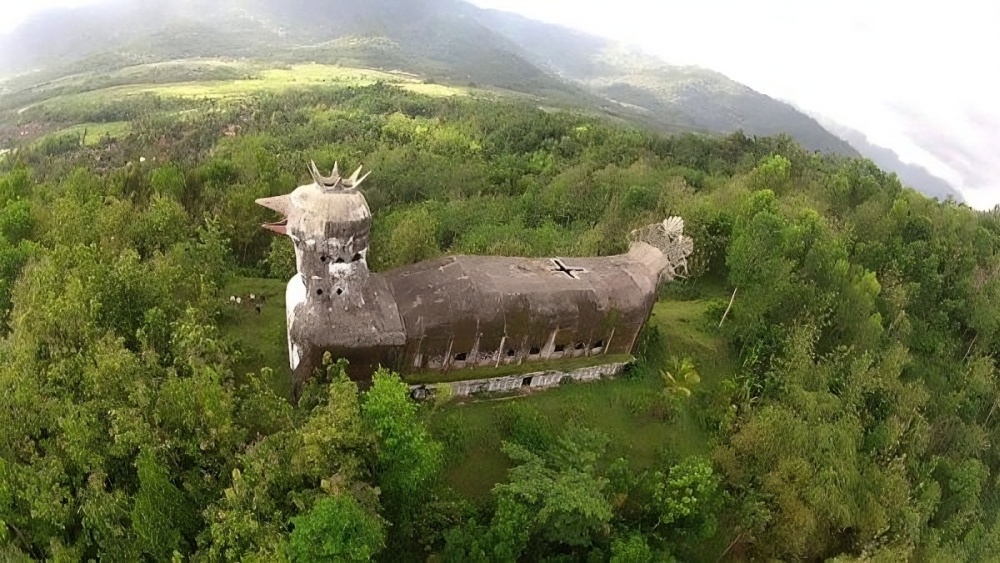
The church’s design, and the fact that it looked abandoned for a while, has inspired many debates and fan theories over the years, each one attempting to answer the mystery of why on earth someone would spend money to build a hollow chicken in the middle of the jungle.
“It was left behind by the Dutch colonists,” one person wrote on Kaskus, a popular Internet forum. “No,” someone replied. “It’s haunted. I’ve seen kuntilanak [vampiric female demons from Indonesian lore] there.”


But the chicken church was neither left here by the Dutch, nor is it haunted by ghosts. It was built by a man named Daniel Alamsjah, who’s now 75.
According to Alamsjah, the building is neither a chicken nor a church. He says he was working in Jakarta when he suddenly received a divine message from God to build a prayer room in the form of a dove. “Perhaps because of my Christian faith, people thought I was building a church,” he said. “But it’s not a church. I was building a prayer house, a place for people who believe in God.”
For some time, the building stayed only 70 percent complete, and Alamsjah could only hope he would be able to finish his masterpiece one day.


But then, fifteen years after the project was halted, in 2015 the chicken church suddenly went viral on international media, with the Daily Mail and the Huffington Post both reporting on it. A year later, the sequel of the Indonesian cult classic film, Ada Apa Dengan Cinta (What’s the Deal With Love) was shot here.
In the wake of the newly gained recognition, tourists started to arrive in large numbers – up to 2,000 a week, according to Alamsjah’s ticket records. Although the entrance fee was nominal (Rp. 10,000, or less than USD $1 per person), the income allowed Alamsjah to finally resume construction.
“I was so relieved,” Alamsjah says. “The locals saw how popular the site was, and they began to benefit as well [from the tourism].”
These days, the chicken church is no longer abandoned. The renovations allowed by the incoming flow of visitors include jeweled tiles, paneled windows, and work on the underground prayer rooms, which are nearly finished. Displays in the main hall (the chicken’s body) document the project’s growth from a divine dream to a full-fledged poultry temple. In fact, the place has become so popular with tourists that Alamsjah even built a small cafe inside the chicken’s rear, selling traditional Indonesian snacks and coffee.
“You know, everyone said I was crazy,” Alamsjah says. “In the 90s, I kept rereading that [Bible] verse, trying to find the courage to continue. My children were very angry at me. I had to keep telling them, this isn’t my plan. This is God’s plan. It’s been 30 years, and I’m glad I continued—thousands of visitors come each year to pray or to reflect on their lives, and my children finally respect what I’ve accomplished.”


Such a leap of faith.
 Donate


Related Posts
The Road to Heaven: China’s Tianmen Mountain Big Gate Road Might Be the Craziest Drive on Earth
The Woman Who Walked Across a Continent Because She Missed Home: Lillian Alling’s Epic Journey
Castel Meur: The Little House Between the Rocks That Refuses to Be a Tourist Attraction
Every Year, the Sea Parts in Korea for a Short Time—A Natural Event Echoing Moses’ Story
The Vikings’ Legacy: Iceland’s Turf Houses – Hobbit Homes That Vanish Into the Landscape
Chariot Races and Hippodromes: Here Are the Best-Preserved Ones That Take You Right Back to Ancient Roman Times
There’s a Museum in Japan Dedicated to Stones That Look Like Faces: The Hall of Curious Rocks
The Island Where Dolls Whisper and Move: La Isla de las Muñecas Is Probably the Creepiest Place on Earth
Tigres Island – Angola’s Eerie Ghost Town Trapped in Time
Norway’s 800-Year-Old Borgund Stave Church Was Built Entirely of Wood, Using Viking Shipbuilding Techniques