Meditation induces notable changes in the brain, and those changes are positive, science says.

Meditation is a practice that involves focusing your attention on a single object, such as your breath, a mantra, or a sensation. Meditation has been practiced for thousands of years in various religious and spiritual traditions, but it has also gained popularity in recent decades as a way to enhance well-being, reduce stress, and improve mental health.
But how does meditation affect your brain? What are the changes that occur in the brain structure and function as a result of regular meditation practice? What are the scientific mechanisms behind the benefits of meditation? The following are some of the latest findings from neuroscience research on how meditation changes the brain and what implications this has for your health and happiness.
Meditation reduces the flow of incoming information and improves attention
One of the effects of meditation is that it reduces the flow of incoming information by slowing down the activity in the brain’s thalamus, which channels sensory data deep into the brain and helps us focus our attention. It also slows the activity of the frontal cortex, which gathers sensory information and places us in time and space.

But why is the reduction in these brain activities considered beneficial? These functions are actually undesirable and contribute to lapses in attention, as well as disorders like anxiety, ADHD, and the accumulation of beta-amyloid plaques in Alzheimer’s disease. This means that meditation helps us tune out irrelevant stimuli and become more aware of the present moment. And, it also improves our focus when we’re not meditating.
Meditation reduces anxiety and increases creativity
Meditation eases anxiety by disrupting specific anxiety-related neural pathways, and it also enhances creativity. Research from Leiden University in the Netherlands, which looked at both forms of meditation and their effects on creativity afterwards, found that participants practicing open-monitoring meditation excelled in generating new ideas.
Moreover, meditation is associated with improved rapid memory recall. A study at the Martinos Center for Biomedical Imaging showed that those practicing mindfulness meditation could swiftly enhance the productivity of distraction-blocking brain waves, potentially explaining their ability to quickly remember and assimilate new facts.

Meditation helps us avoid overreacting to sensations and approach fear in a more rational way
Within our brains, there exists a region referred to as the ‘Me Center,’ formally known as the medial prefrontal cortex, responsible for processing information related to ourselves and our experiences. Typically, signals from bodily sensations and fear centers are directed to this ‘Me Center,’ establishing robust neural pathways. However, when engaged in meditation, these neural connections are attenuated, reducing our reactive responses to sensations.
Simultaneously, the connection to the ‘Assessment Center’ in our brains, recognized for its role in reasoning, is strengthened. Through meditation, we gain the capacity to encounter frightening or distressing sensations and approach them with greater rationality, minimizing the tendency to overreact.
Meditation increases gray matter density and cortical thickness
Another effect of meditation is that it increases the gray matter density and cortical thickness in certain regions of the brain that are involved in learning, memory, emotion regulation, and self-awareness. Gray matter is the tissue that contains most of the brain’s neurons, while cortical thickness is a measure of how many layers of neurons are in a given area of the cortex.
Research has indicated a rise in gray matter density in the hippocampus, a brain region linked to memory and learning, and in other brain regions related to emotion regulation and self-awareness.
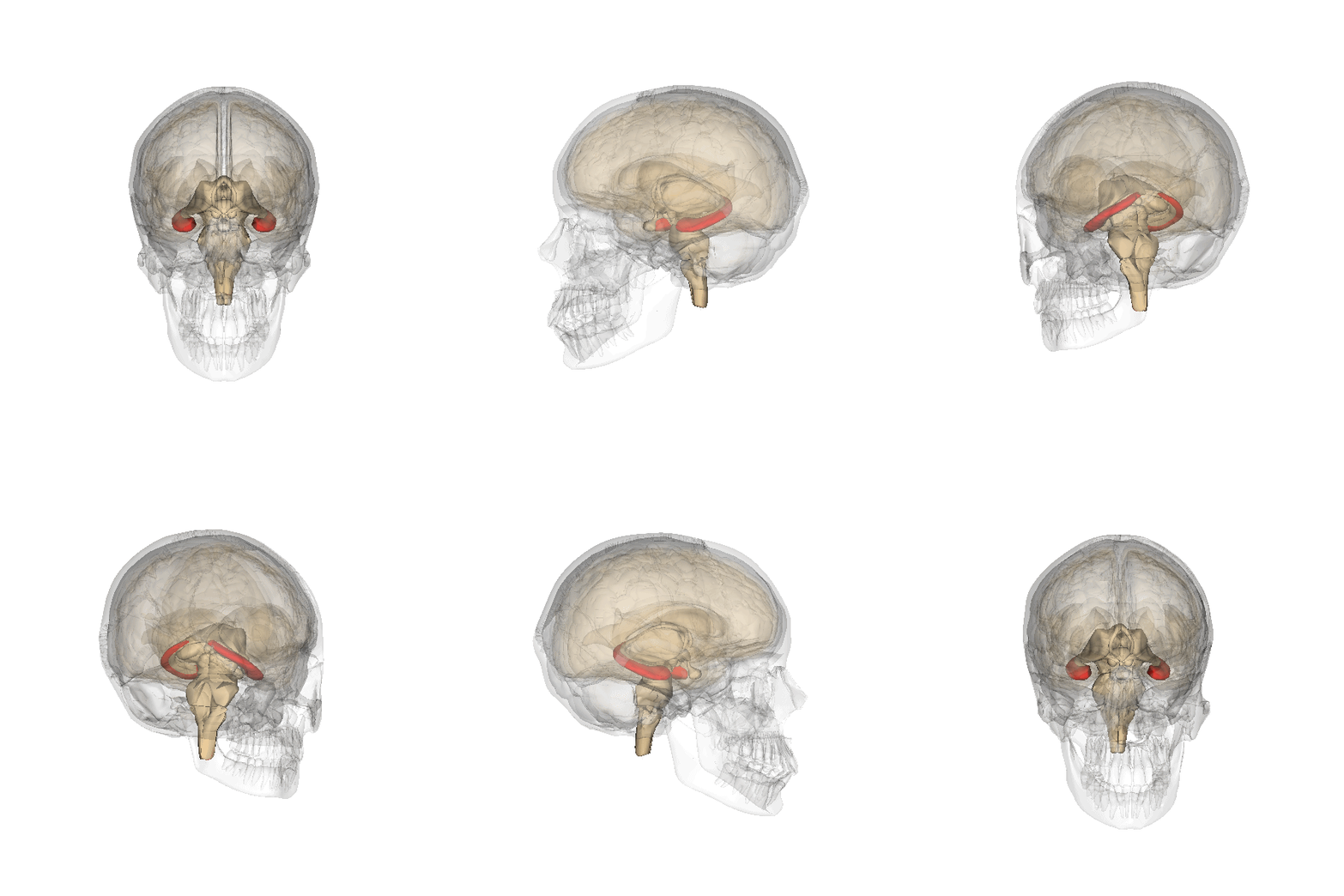
Furthermore, meditation can increase the cortical thickness in areas such as the anterior insula, which is involved in interoception (the awareness of internal bodily sensations) and empathy. This means that meditation can lead to more positive emotions, longer-lasting emotional stability, and heightened focus during daily life.

Meditation has the added benefit of attenuating age-related changes in gray matter and mitigating the decline in cognitive function. Furthermore, individuals who practice meditation show increased levels of gyrification, the folding of the cerebral cortex due to growth. This augmentation enhances the brain’s efficiency in processing information, decision-making, memory formation, and attention improvement.
Meditation enhances neural connectivity
Meditation enhances the connectivity of neural pathways, which are the networks of neurons that communicate with each other across different brain regions. Meditation can improve the communication between different brain systems, such as those related to attention, emotion, and self-referential processing.
For example, meditation can enhance the connectivity between the prefrontal cortex (the executive center of the brain) and the amygdala (the emotional center of the brain), which can help us regulate our emotions more effectively. Meditation can also reduce the activity of the default mode network (DMN), a brain network associated with mind-wandering and self-related thinking. A lower activity of the DMN can lead to less rumination and more focus.

Meditation leads to changes in brain waves
Meditation also leads to changes in brain waves, which are the patterns of electrical activity that can be measured by electroencephalography (EEG). Brain waves reflect different states of consciousness, such as wakefulness, sleep, or relaxation. Many studies on mindfulness meditation, assessed in a review by Cahn and Polich in 2006, indicate that meditation tends to lead to an increase in the production of theta and alpha waves, which are the brain wave frequencies associated with enhanced learning abilities and overall mental well-being. Theta waves are also linked to creativity and insight, while alpha waves are related to relaxation and reduced stress.
Moreover, some advanced meditators can produce gamma waves, which are the highest frequency brain waves and are associated with peak performance and cognitive integration. All in all, these findings suggest that in meditative absorption a person is more relaxed while also maintaining a sharp awareness.
So let’s start meditating!
Meditation is a powerful practice that can change your brain in many ways. By meditating regularly, you can reduce the flow of incoming information, increase your gray matter density and cortical thickness, enhance your neural connectivity, and alter your brain waves. These changes result from the brain’s neuroplasticity, its ability to form new connections and alter its structure in response to experiences.

By meditating, you can improve your mental clarity, lower your anxiety, decrease your depressive symptoms, and increase your sense of well-being. And, most importantly, you can be a better person not only for yourself, but for others too – including your family, friends, colleagues and just anybody!
So why not start, if you haven’t already?
 Donate


Related Posts
Meet Lanmaoa asiatica: The Mushroom That Can Make You See Little People
How the Babylonians Counted to 60 Using Their Hands and Changed Mathematics Forever
Out the Window at Midnight: Furniture, Bathtubs, and a Neapolitan New Year
Love in a Bottle: A Note at Sea That Changed Two Lives
Ötzi the Iceman: New Clues Reveal a Different Story Behind His Death
When a Group of Drunk Guys Drove a Soviet Tank Through a Polish Town to Buy Beer
Scientists Painted Cows Like Zebras — and It Cut Fly Landings by Half
The Man Who Outsprinted Time: The Incredible Story of Gustaf Håkansson, the “Steel Grandpa”
‘Dark Oxygen’ Found on Ocean Floor Challenges What We Thought About Life’s Origins
500 Days in Darkness: The Long-Buried Story of Priest’s Grotto, a Holocaust Refuge in One of the World’s Longest Caves