By splitting data into a spectrum of color packets, scientists got a single computer chip to transmit a record 1.84 petabits of data per second via a fiber-optic cable.

Researchers at the Technical University of Denmark in Copenhagen transmitted 1.84 petabits of data per second through an optical cable using a revolutionary computer chip, New Scientists reports. That’s 230,000 gigabytes in a single second, nearly double the data traffic passing through the entire backbone of the internet every second.
Asbjørn Arvad Jørgensen and his colleagues used a photonic chip – a technology that allows optical components to be built onto computer chips – to split a data stream into thousands of separate channels and transmit them simultaneously over a 7.9-kilometre optical cable. The data stream was first broken down into 37 sections, each of which was sent through a single glass core in the cable, and then each section was further divided into 223 further chunks, each of which existed in a different part of the electromagnetic spectrum.
The frequency comb, as it is called, consists of light peaks equally spaced across the spectrum and allows data to be transmitted simultaneously in different colors without interfering with each other, thus significantly increasing the capacity of each core. The research has broken records for data transmission using a single chip as a light source and could enable the production of simple chips that can transmit much more data using much less power.
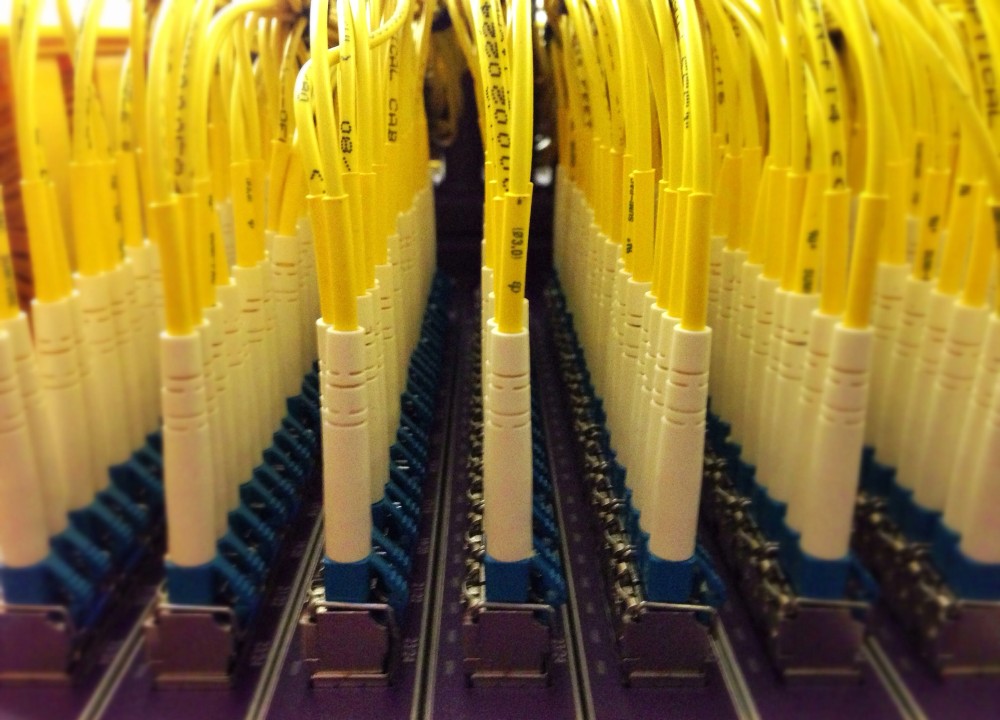
The amount of data sent in the course of the experiment was actually so vast that no currently existing computer could process this much information so quickly. For this reason, the researchers passed “dummy data” through all channels, testing the output one channel at a time to verify it has indeed been sent and could be recovered intact.
“You could say the average internet traffic in the world is about a petabit per second. What we transmit is two times that,” Jørgensen said. “It’s an incredibly large amount of data that we’re sending through, essentially, less than a square millimetre [of cable]. It just goes to show that we can go so much further than we are today with internet connections.”
The chip requires a single continuously-lit laser split into multiple frequencies and devices that encode data in each output direction. According to Jørgensen, these external devices can be built into the chip itself, so the whole device would be the size of a matchbox.
We can’t wait till it’s mass produced…
 Donate


Related Posts
‘Dark Oxygen’ Found on Ocean Floor Challenges What We Thought About Life’s Origins
Tiny But Mighty: Korean Scientists Develop Ant-Inspired Robot Swarms That Redefine Teamwork in Technology
The City of Ulm in Germany Made Thermally Insulated Pods for the Homeless to Sleep In
When They Fed Toilet Paper Into a ’50s Supercomputer to Keep It Running
One of the Oldest Known Engineered Roadways Is a 5,830-Year-Old Timber Causeway That Has Been Remarkably Well-Preserved
1000 Years Ago, a Viking Lost His Chest – Here’s What Was Inside
AI Built by College Student Spots Potential Evidence of Extraterrestrial Civilizations
Before Electricity, People Used These Candle Clocks to Tell the Time and Wake Up
These Wavy Fences Called ‘Crinkle Crankle Walls’ Actually Use FEWER Bricks Than a Straight Wall
Mom Imposes Screen Detox On Children, Changing The Entire Family’s Life