Glowing dogs in the sky.

Sun dogs, also known as parhelia, are a fascinating atmospheric phenomenon that occurs when the sun is low on the horizon. Sun dogs appear as bright spots of light on either side of the sun, creating a dazzling spectacle that can capture the attention of anyone lucky enough to witness it.
The term “sun dog” (or mock sun) originates from Greek mythology and was used to refer to the bright “false suns” visible on either side of the sun’s disk, which were believed to be the dogs of the god Zeus as he walked them across the sky.
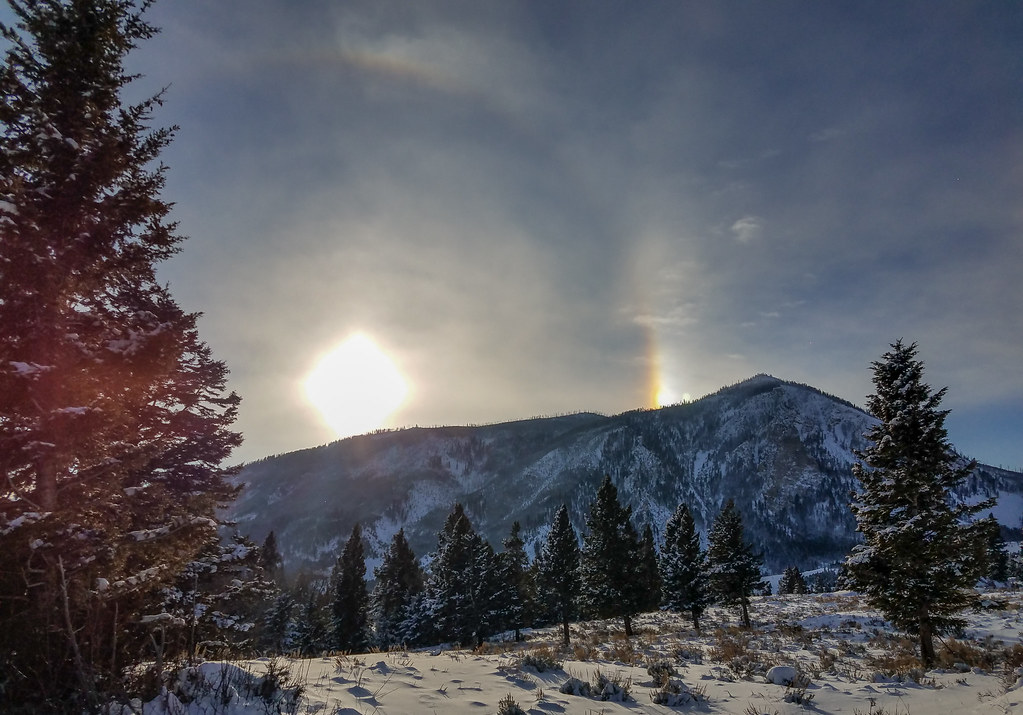
Sun dogs are formed when sunlight is refracted by ice crystals in the atmosphere. The ice crystals act like tiny prisms, bending and splitting the light into its various colors. When this happens, the light can create a halo around the sun and create the appearance of two bright spots on either side.
The shape and position of sun dogs can vary depending on the size and shape of the ice crystals in the atmosphere. They are most commonly seen when the sun is low on the horizon, typically during sunrise or sunset.

Sun dogs appear as bright spots of light on either side of the sun, creating a halo-like effect. The colors of the sun dogs can vary, but they are typically a mix of red, orange, and yellow. The colors are created by the refraction of the sunlight as it passes through the ice crystals in the atmosphere.
Sun dogs can also be accompanied by other atmospheric phenomena, such as halos around the sun and a brightening of the sky known as the “Bishop’s Ring.” These additional phenomena only add to the beauty and intrigue of the sun dog display.
Sun dogs can be seen all over the world, but they are most commonly observed in cold and dry climates. This is because the ice crystals that create the sun dogs need a specific environment to form. They are most often seen in polar regions, such as Canada, Alaska, and Scandinavia, but can also be observed in other regions with the right weather conditions.

If you want to observe sun dogs, the best time to look is during sunrise or sunset when the sun is low on the horizon. Look towards the sun and scan the sky for the bright spots of light on either side. Sun dogs can be seen with the naked eye, but using binoculars or a camera can help you get a closer look and capture the beauty of the phenomenon.
Oh, and one more thing. There exist moon dogs too! Check out this amazing photo of a moon corona, halo, arcs and moon dogs that appeared over Manitoba, Canada.

Absolutely amazing.
 Donate


Related Posts
How a Record-Breaking Lightning Bolt Broke the Sky Across Nearly 500 Miles
No Hurricane Ever Crossed the Equator and Here’s Why
Finally I Got Lucky and Photographed Some Incredible Mammatus Clouds Over Tapolca, Hungary
Don’t Panic, It’s Vivipary! When Seeds Germinate Inside the Fruit
Incredible Waterspout in Florida’s Tampa Bay Caught on Camera While Making Landfall
Mystery of the Marfa Lights: UFOs or Natural Phenomenon?
Leaves Cast Crescent Moon-Like Shadows During a Solar Eclipse and Here’s Why
The Indian Ocean Has the World’s Largest Gravity ‘Black Hole’ and It’s Finally Explained
Where Does the Water Go? The Mystery of the Devil’s Kettle Waterfall Has Long Puzzled Visitors but Now We Have an Answer
Cross Sea: The Amazing Phenomenon of Square Waves