We are all familiar with the enigmatic smile of the “Mona Lisa,” but that famous face recently displayed a stunning new range of expressions, thanks to artificial intelligence (AI).

Russian scientists have created a facial learning algorithm that is capable of producing personalized talking head models from just a few image views of a person, potentially even a single image. With the new technology – a type of AI that processes information much as a human brain does, to analyze and process images – even portrait paintings can be brought to life.
In a recent video shared to YouTube on May 21, three video clips show some eerily life-like examples of the Mona Lisa as she appears to talk and move her head. Just look at how startling it is to see her in “real” life. (Large image, may take some time to load)
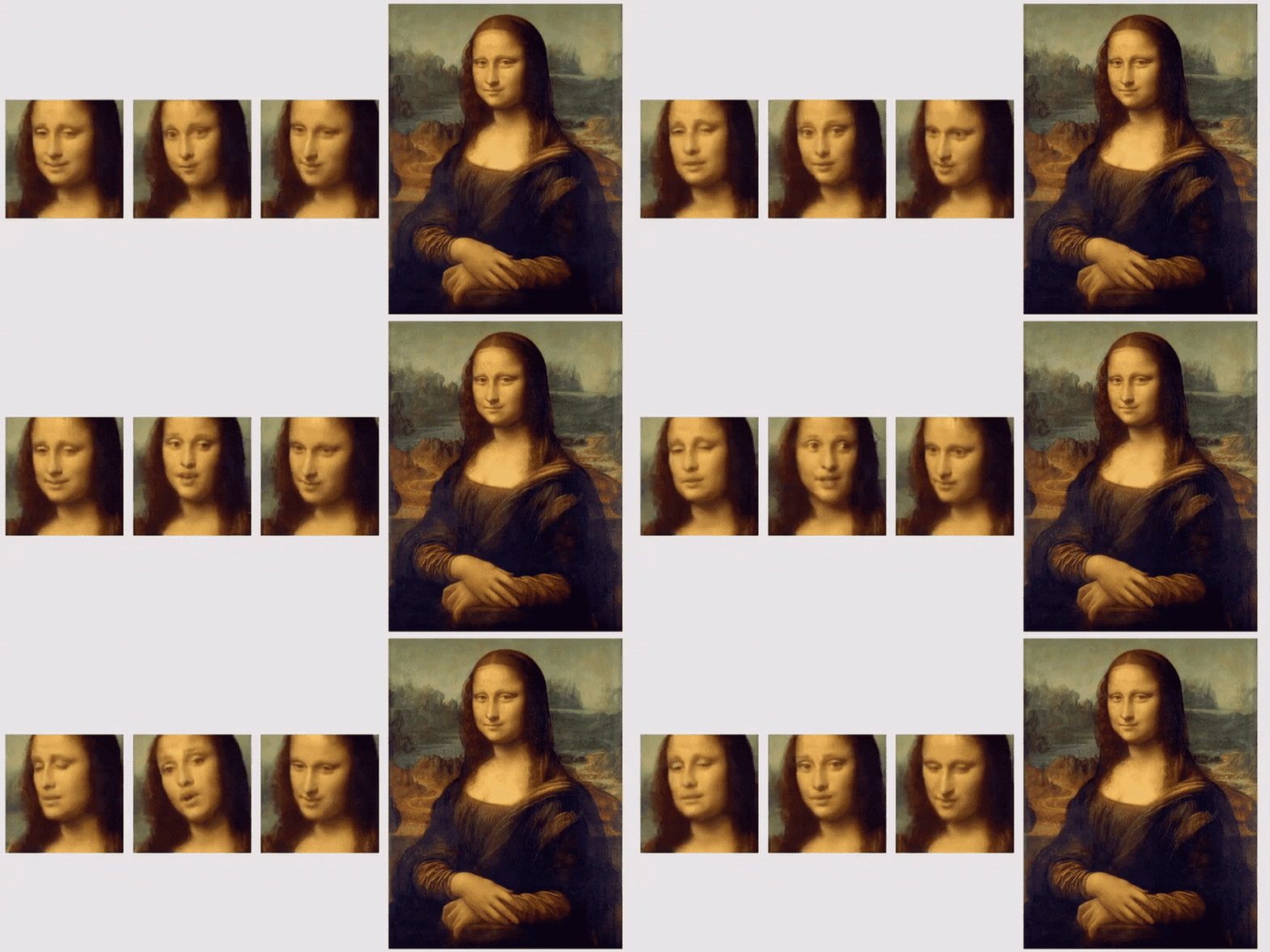
The research team trained the algorithm to understand the general shapes of facial features and how those shapes behave relative to each other. After applying that information to still images, they ended up with a realistic video sequence of new facial expressions created from a single frame.
For the Mona Lisa videos, the AI “learned” facial movement from datasets of three human subjects, producing three very different animations. While each of the three clips was still recognizable as the Mona Lisa, variations in the training models’ looks and behavior lent distinct “personalities” to the “living portraits,” study lead author Egor Zakharov, an engineer with the Skolkovo Institute of Science and Technology, and the Samsung AI Center (both located in Moscow), explains in the video in which other paintings also come to life.
The scientists realize that their technology can have a negative use in the area of so-called “deepfake” videos, but they point out that Hollywood has been making fake videos (aka “special effects”) for a century, and deep networks with similar capabilities have been available for the past several years. In fact, they are hopeful that their work will contribute to the democratization of the certain special effects technologies, underlining that the democratization of technologies has always had negative side effects.
 Donate


Related Posts
Tiny But Mighty: Korean Scientists Develop Ant-Inspired Robot Swarms That Redefine Teamwork in Technology
The City of Ulm in Germany Made Thermally Insulated Pods for the Homeless to Sleep In
Art in the Background: How a Missing Hungarian Painting Was Found in ‘Stuart Little’
The Enduring Mystery of the Cave of Swimmers: Did Ancient Egyptians Swim in the Sahara?
Buried in Ash for 3,600 Years, Bronze Age Akrotiri Reveals Minoan Life With Stunning Frescoes and Multi-Story Buildings
Could These 4,000-Year-Old Aboriginal Cave Paintings in Australia Really Depict Aliens?
Mystery of the 7000-Year-Old Dabous Giraffes, the World’s Largest Known Animal Petroglyphs
This 12,000-Year-Old Wooden Sculpture Is the Oldest in the World: The Shigir Idol, a Mesolithic Masterpiece
Dinosaur Rock Art: Did Dinosaurs Coexist With Humans?
The Cosquer Cave in France Is the Only Cave With Prehistoric Drawings That Has an Entrance Under the Sea