
Just in time for the holiday season, astronomers have showcased a stunning cosmic formation that naturally resembles a decorated Christmas tree. Located 2,500 light-years away in our Milky Way galaxy, NGC 2264 – known as the Christmas Tree Cluster – contains young stars between one and five million years old, ranging from tiny ones just a tenth the mass of our Sun to giants seven times more massive.
A new composite image enhances the cluster’s festive appearance through strategic color choices and rotation. The “pine needles” appear in green, created by gas visible in optical data from the National Science Foundation’s WIYN telescope. Here’s another view of the festive galactic cluster.
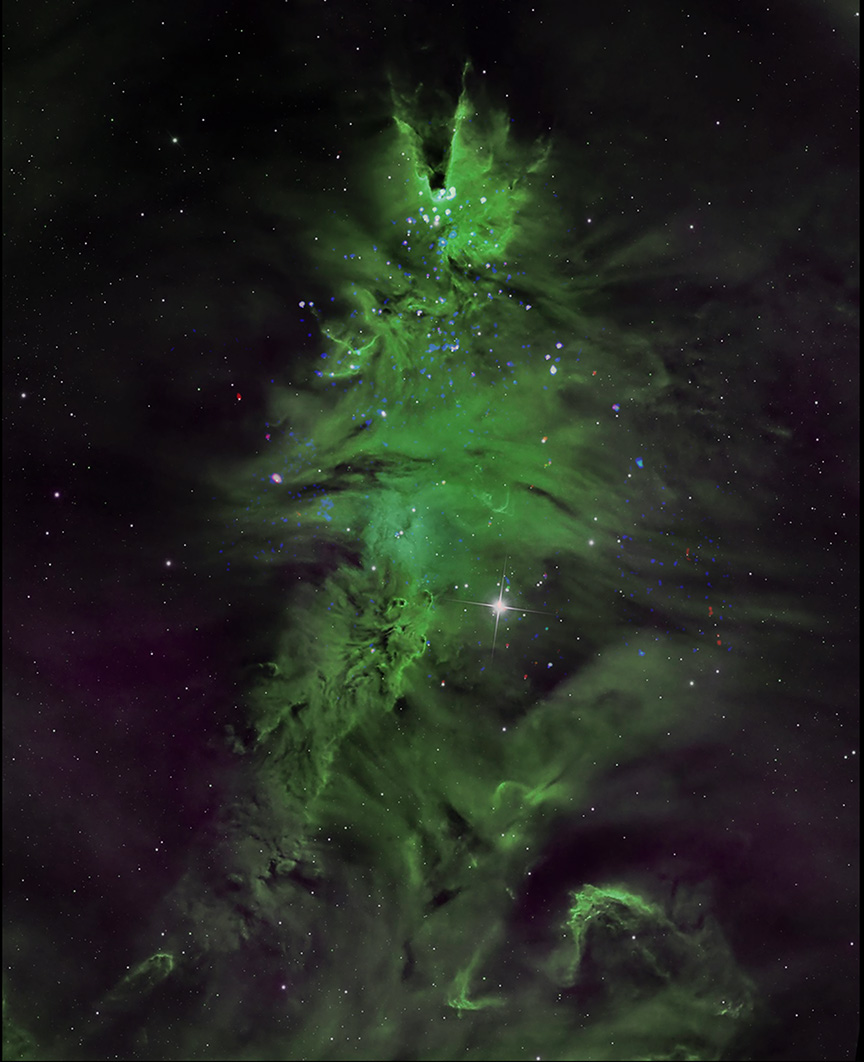
NASA’s Chandra X-ray Observatory captured the “lights” – young stars that appear as blue and white dots. Additional stars in the foreground and background shine like white ornaments, detected in infrared by the Two Micron All Sky Survey.
And wait, here’s an animated version too!
While the stars in NGC 2264 don’t actually twinkle in unison, they do exhibit dramatic variations in brightness. These changes occur through several processes: powerful flares dwarfing those of our Sun, rotating hot and dark spots on stellar surfaces, and fluctuations in the surrounding gas and dust. The image was rotated 160 degrees clockwise to position the conical tree shape upright, though astronomers typically orient their images with north pointing up.
The Christmas Tree Cluster shares its celestial neighborhood with other remarkable features, including the Cone Nebula, the Snowflake Cluster, and the Fox Fur Nebula. Together, these objects form a complex region of ongoing star formation, where dust clouds combined with hydrogen and helium continue producing luminous new stars.
NASA has unveiled another festive image for the holiday season, featuring NGC 602, a stunning star cluster located at the edge of the Small Magellanic Cloud. Resembling a wreath adorned with twinkling Christmas lights, the image reveals a charming surprise upon closer inspection: those tiny lights aren’t just stars, but entire galaxies lying far beyond the cluster. (For context, the cluster itself is approximately 200,000 light-years away from Earth.)

NASA crafted the image by blending data from the Chandra X-ray Observatory and the James Webb Space Telescope. Chandra’s X-ray data highlight the young stars within the cluster in red, while Webb’s infrared data reveal clouds of dust in vibrant shades of orange, yellow, green, and blue.
 Donate


Related Posts
The Best View of the Distant Universe Ever Captured Shows Galaxies From Over 13 Billion Years Ago
Mesmerizing Timelapse Reveals Jupiter’s Cloud Belts Moving at Different Speeds and Directions
First Images from Titan: The Only Photos Ever Taken from the Surface of Another Moon
What Is This Strange Square on Mars Everybody’s Talking About, and Are There Other Man-Made Looking Structures?
The Himalayas from Space: Stunning Views of Earth’s Tallest Peaks Like You’ve Never Seen Before
The Day Siberia Was Set Ablaze: The Mysterious Tunguska Event and How Close We’ve Gotten to Explaining It
Apollo Astronauts Left Bags of Poop on the Moon and We Need to Get Them Back
The Most Beautiful Meteorite Ever Found? The Cosmic Appeal of the Fukang Pallasite
The Wow! Signal: When We Got an Extraterrestrial Message From Space
Volcano Eruptions Look Incredibly Amazing From Space – Here Are the Best Images