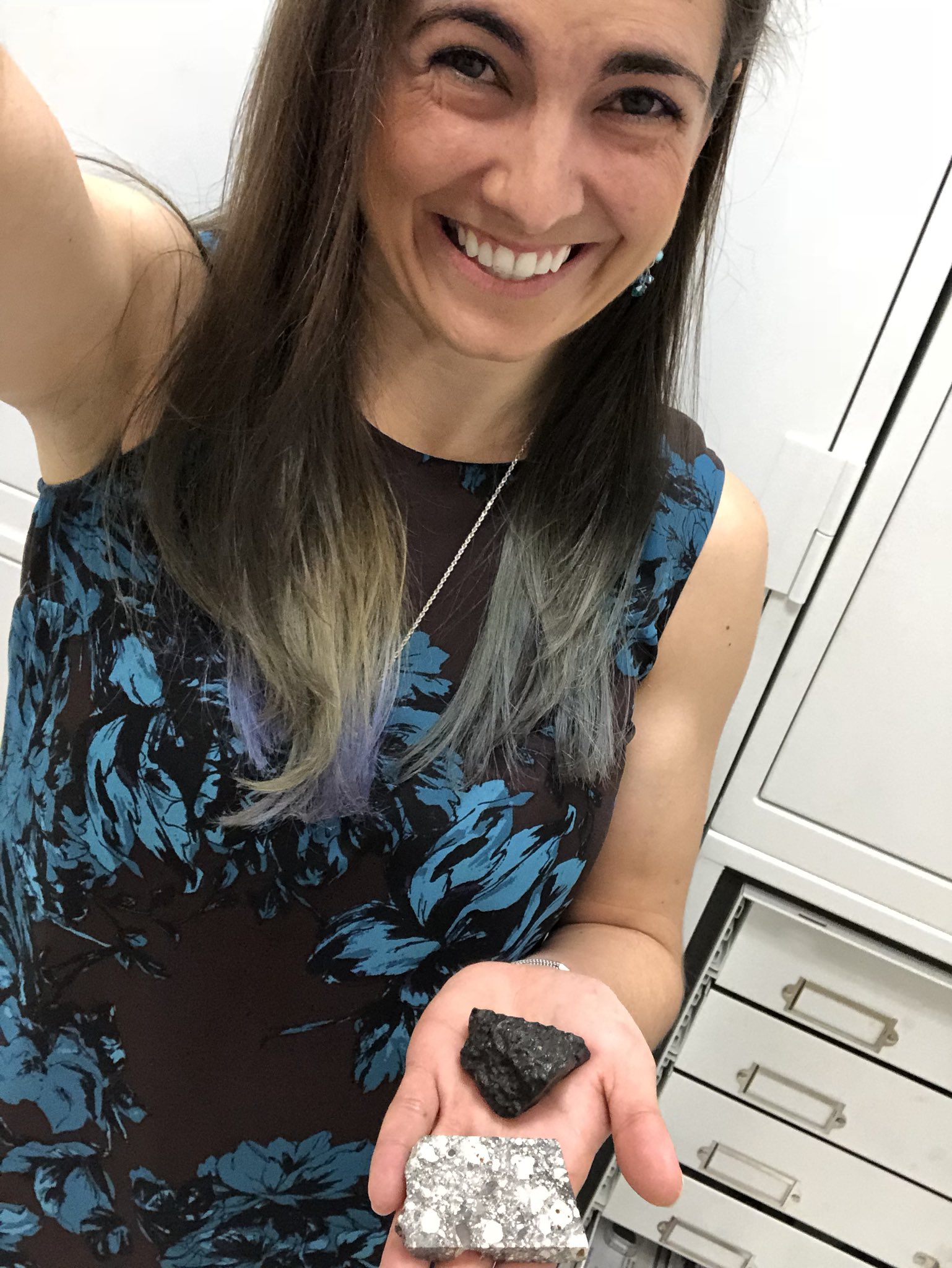
Sarah Hörst, Assistant Professor of Planetary Science at Johns Hopkins University recently found herself in an interesting situation: she got a chance to hold pieces of the Moon and Mars – on Earth. Wow, what a planetary constellation… She shared her excitement on Twitter:
This is what my face looks like when someone lets me hold a piece of the Moon and Mars at the same time pic.twitter.com/wMN1HhXKpW
— Dr./Prof. Sarah Hörst (@PlanetDr) April 13, 2018
Hörst also took time to answer some of the most common questions:
- The black piece of rock is the Martian one, the gray one is from the Moon.
- We’ve never had a sample return mission from Mars – how come we have rock from there? Well, it landed on Earth after something crashed into Mars and sent rocks flying through space and all the way to our planet.
- But how do we know it is from Mars and not some other place? The chemical composition and isotopes match measurements of Mars from spacecraft we’ve sent there and don’t match anything else.
- You can read more about the Martian meteorites here.

 Donate


Related Posts
The Best View of the Distant Universe Ever Captured Shows Galaxies From Over 13 Billion Years Ago
Mesmerizing Timelapse Reveals Jupiter’s Cloud Belts Moving at Different Speeds and Directions
First Images from Titan: The Only Photos Ever Taken from the Surface of Another Moon
What Is This Strange Square on Mars Everybody’s Talking About, and Are There Other Man-Made Looking Structures?
The Himalayas from Space: Stunning Views of Earth’s Tallest Peaks Like You’ve Never Seen Before
Chirstmas Tree and Christmas Lights: NASA Space Telescopes Show What the Festive Season Looks Like in Space
The Day Siberia Was Set Ablaze: The Mysterious Tunguska Event and How Close We’ve Gotten to Explaining It
Apollo Astronauts Left Bags of Poop on the Moon and We Need to Get Them Back
The Most Beautiful Meteorite Ever Found? The Cosmic Appeal of the Fukang Pallasite
Why the Hoba Meteorite Left No Impact Crater Despite Being Earth’s Biggest Space Rock and Chunk of Iron