You are looking at two identical images.

The leaning tower illusion refers to a visual phenomenon observed in two identical images of the Leaning Tower of Pisa captured from beneath. Despite being duplicates, one perceives that the tower on the right inclines further, as if photographed from a different angle. This intriguing illusion was discovered by Frederick Kingdom, Ali Yoonessi, and Elena Gheorghiu from McGill University, earning them the top prize in the 2007 Best Visual Illusion of the Year Contest.
The leaning tower illusion demonstrates how our brain utilizes the convergence angle of two inclined objects as they retreat into the distance, enabling it to determine the relative angle between them. In instances where two parallel towers, such as the iconic Petronas Twin Towers in Kuala Lumpur, are captured in a single photograph, we perceive them as parallel due to their apparent convergence in the distance as they recede.

Consequently, when the outlines of a pair of identical objects, which are receding, appear parallel in their two-dimensional projection, it indicates that these objects cannot be physically parallel. Instead, they must be diverging as they move away from our view. This phenomenon is distinctly noticeable in the [below image], where the right-hand tower has been substituted with an exact replica of the one on the left. As a result, the corresponding outlines become parallel, creating the visual perception of the two towers diverging from each other.

To give you another example (and this shows that the leaning tower illusion doesn’t only work with towers): In the first image below, the two parallel tram lines are perceived to converge in the distance, as expected.

However, If the two parallel tram lines do not converge as they recede in the distance, the brain mistakenly perceives them as nonparallel and diverging (below). Again, you’re looking at two identical images.

Interesting, isn’t it?
Now let’s play a little game.
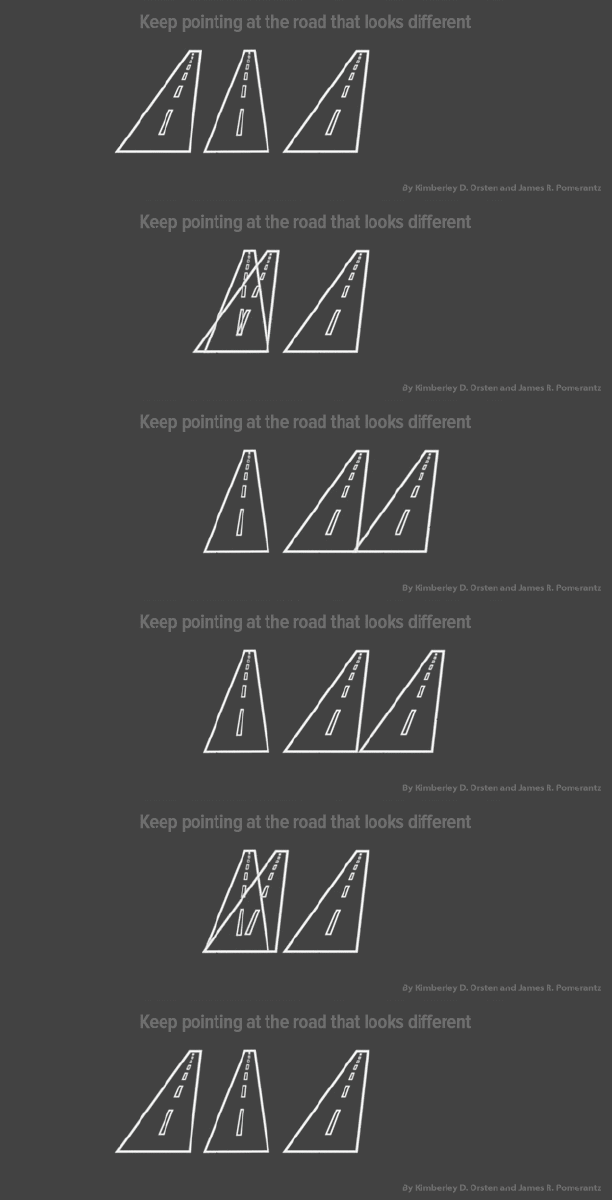
The illusion observed in side-by-side replicas of a receding object’s image also extends to a single object, as demonstrated by the image below. Despite the figure being drawn with parallel sides, the perception generated is that of an object that progressively widens as it moves away in the distance.

That said, our brain is rather picky as to when we are to see the leaning tower illusion, only applying its depth perception tool kit in specific situations. When observing the two tilted Japanese manga girls below, for example, the phenomenon does not occur.

Why? Because the cartoon images lack the perception of depth, causing our brain to not anticipate their convergence in the distance.
 Donate


Related Posts
What Would Earth Look Like With Saturn’s Rings?
Slime Moulds Don’t Only Look Fascinating, They’re Also Much Smarter Than You’d Expect
Incredibly Rare Yellow Penguin Photographed for the First Time Ever
Art of the Earth: These Amazing Satellite Images Look Like Abstract Paintings
Nightmare Fuel Around the World: What “Boogeyman” Looks Like in Different Countries
“The Last Free Place on Earth”: The Unincorporated, Off-Grid Alternative Lifestyle Community of Slab City
Century-Old Negatives Found in Block of Ice in Antarctica
Pretty Celebrities Turn Ugly in This Shocking Illusion
Heavenly Halos: Unveiling the Enchanting Optical Wonders of the Sky
You Have to Shake Your Head to See This Illusion